
Finding Shawnee Resident Records
No official office keeps a master list of everyone living in Shawnee. Johnson County property systems connect owners and mailing addresses to parcels; Kansas VoterView confirms an individual registration; deeds identify parties to land instruments; and historical directories preserve dated household or business entries. Begin with the source that matches the information already available. An address belongs in AIMS and the tax search, while a name and date of birth fit the voter lookup. An older street or family name belongs in library, archive, and directory collections.
Keep ownership and residence separate. A parcel owner may live elsewhere, a billing address may differ from the site address, and renters usually will not appear in land records. One matching name also is not enough. Save the exact record title, date, address label, and jurisdiction, then confirm the lead in a second independent source.
- Check Johnson County AIMS by address, parcel, or owner and note whether a field is a site or billing address.
- Use Kansas VoterView for an individual registration and polling-place check.
- Follow land history through the Johnson County Register of Deeds index or its public terminal.
- Move older questions to Johnson County Library, JoCoHistory, County Archives, KSHS, and Library of Congress directory holdings.
- When no portal exposes the needed record, send a focused Kansas Open Records Act request to the office that keeps it.
Shawnee Resident Record Keepers
Shawnee City Hall keeps municipal proceedings, ordinances, permits, licenses, and defined city records. Most address and land work crosses into Johnson County: AIMS maps the parcel, the Appraiser handles valuation, the tax system tracks billing, and the Register of Deeds preserves recorded instruments. The Johnson County Election Office handles voter-data requests, while the state operates the individual VoterView check. These offices sit in different systems and sometimes different cities. The county seat is Olathe, so a Shawnee record request may properly go there. For address-by-address methods, use the Shawnee street directory.
Johnson County Register of Deeds
111 S. Cherry St., Suite 1200
Olathe, KS 66061
Johnson County Appraiser
County Administration Building
Olathe, Kansas
AIMS Links Shawnee Addresses
AIMS Location Services is the strongest first stop for a Shawnee address because its card keeps several kinds of geography together. Search fields and map tools can connect the site address, owner or billing address, legal description, lot and block, subdivision, KUPN, quick reference, land use, ZIP, ward, precinct, schools, utilities, FEMA information, and nearby public places. The labels matter: “Owner Information/Billing Address” is not the same thing as “Site Address,” and neither alone proves who currently occupies a home.
The safe sample in the research is Shawnee City Hall at 11110 Johnson Drive. Its public card demonstrates how a legal description, KUPN, quick reference, zoning, coordinates, building data, and civic geography fit together without exposing a private household. Use that same field-by-field discipline for any address, then open the dedicated street records workflow for deeds, plats, and adjacent parcels.
The official AIMS location card shows the county interface used to cross-check a Shawnee parcel.
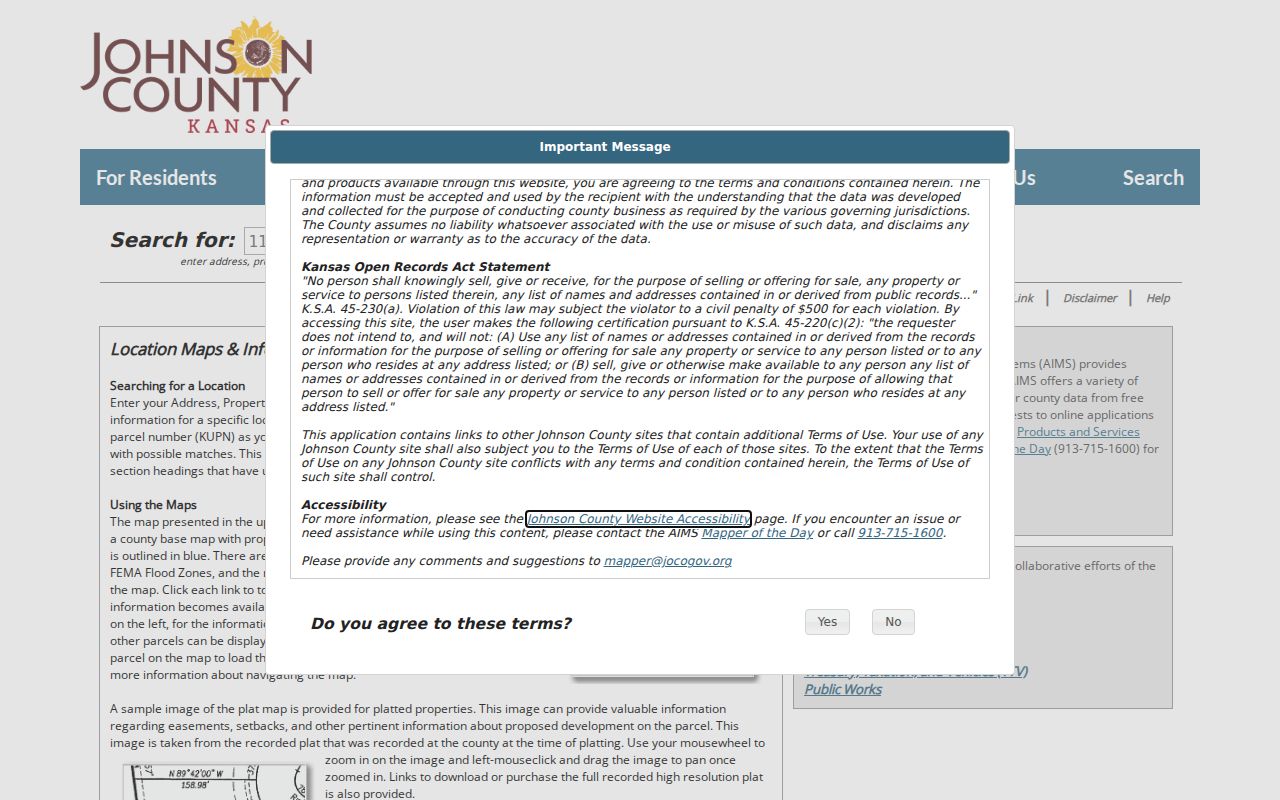
The card is useful because it keeps address type, parcel identity, and civic layers visible rather than collapsing them into a single resident claim.
Shawnee Deed Record Changes
Johnson County is changing how deed-index access works. The Register of Deeds document-library notice says a new electronic records management system is anticipated in fall 2026, and the legacy subscription service stopped accepting new subscriptions on July 1, 2026. Do not promise that an old login route still works. Record the date checked and look for the new public-access link on the county page.
The office remains an access channel during the transition. Its public terminal is free to use, and requests may also proceed through the counter, mail, eRecording where applicable, or a defined KORA request. The guide describes documents from 1920 through 1987 in legacy material and plats from 1866 forward. Kansas indexing law calls for reception time, grantor, grantee, instrument type, volume and page, remarks, tract description, and release or satisfaction references. Those fields can tie a name to an instrument, but the deed still shows a legal transaction, not automatic present occupancy.
The official Johnson County Register of Deeds page identifies the office and its public-access routes.
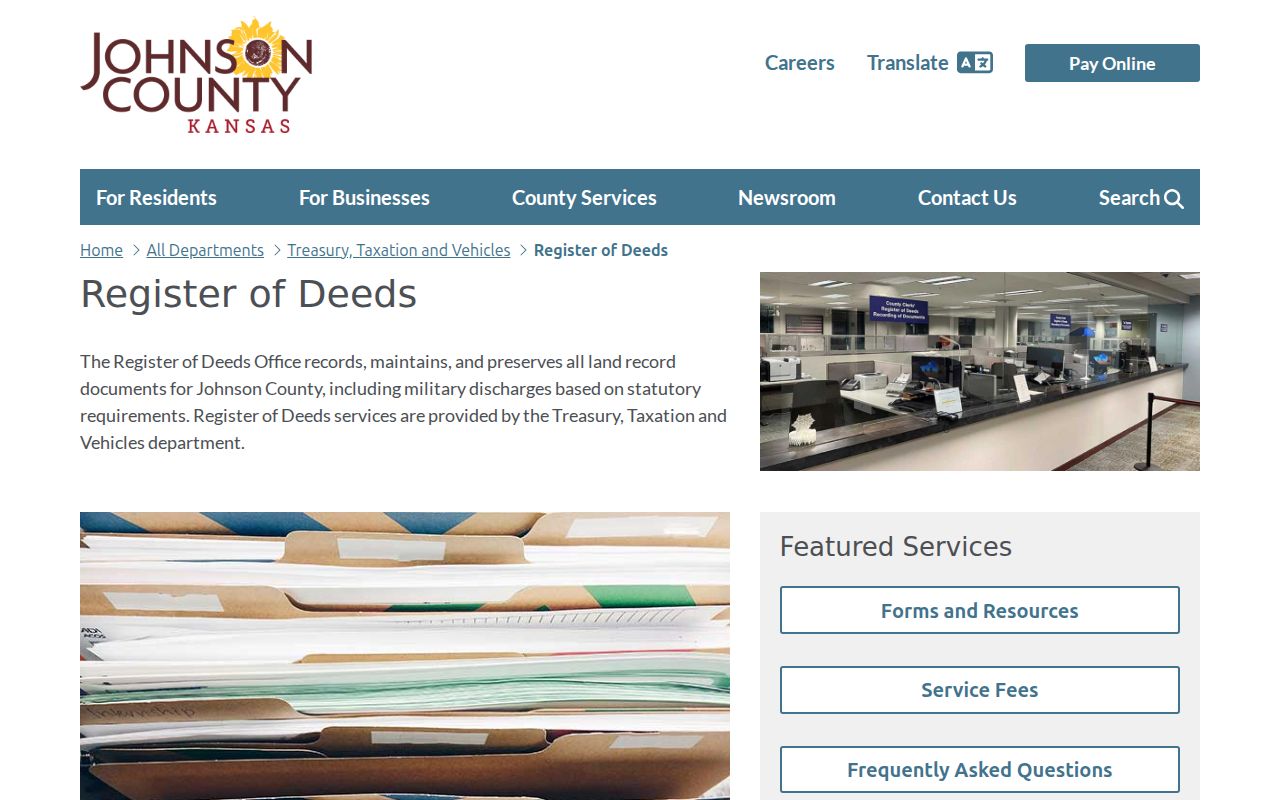
Use the county notice as the current authority for access during the system transition, rather than relying on an old subscription link.
KORA Requests for Shawnee Records
The Shawnee City Clerk is the municipal records custodian and Freedom of Information Officer. City proceedings, ordinances, resolutions, contracts, appointments, agendas, minutes, notices, and records requests belong there. Shawnee also uses CivicWeb for meeting material and routes certain Clerk, Court, and Fire requests through that portal. County land, tax, court, and election records must go to their own Johnson County custodians instead.
Under the Kansas Open Records Act, K.S.A. 45-215 et seq., ask for an identifiable existing record. The City brochure explains that requests should be specific, fees may apply, and an office may provide a response or explanation within the statutory process. KORA does not require an agency to create a new residents list or answer a broad research question. A useful request names the department, record series, date range, address or case identifier, and preferred format. If the first office does not keep the item, ask which custodian does.
Current Shawnee Directory Sources
Current official sources are narrow by design. AIMS and tax records describe parcels and owners. VoterView returns an individual registration result after the user supplies identifying fields. The deed index names parties to recorded instruments. City systems identify public officials, meeting participants, license or permit records, and association contacts only within their stated purpose. Read each result as a dated record from its custodian, not as a complete directory of Shawnee households.
| Shawnee source | What a match means | Custodian | Route |
|---|---|---|---|
| AIMS and tax search | Owner, billing, parcel, or tax account data | Johnson County | Online map and tax portal |
| Kansas VoterView | Individual registration and polling information | Kansas and county election offices | Online lookup |
| Recorded instrument index | Grantor, grantee, lien, mortgage, or plat party | Register of Deeds | Terminal, index, mail, or request |
| CivicWeb and city records | Official city action or named municipal record | Shawnee City Clerk | Portal or KORA request |
| Homes Association portal | Private association name and contact role | Private associations via City listing | Public directory |
For one person, the safest method is to compare fields rather than collect loosely similar names. The Shawnee resident lookup explains how dates, jurisdictions, and source types distinguish one individual from another.
The Johnson County property tax search offers a separate billing and payment-status view of a parcel.
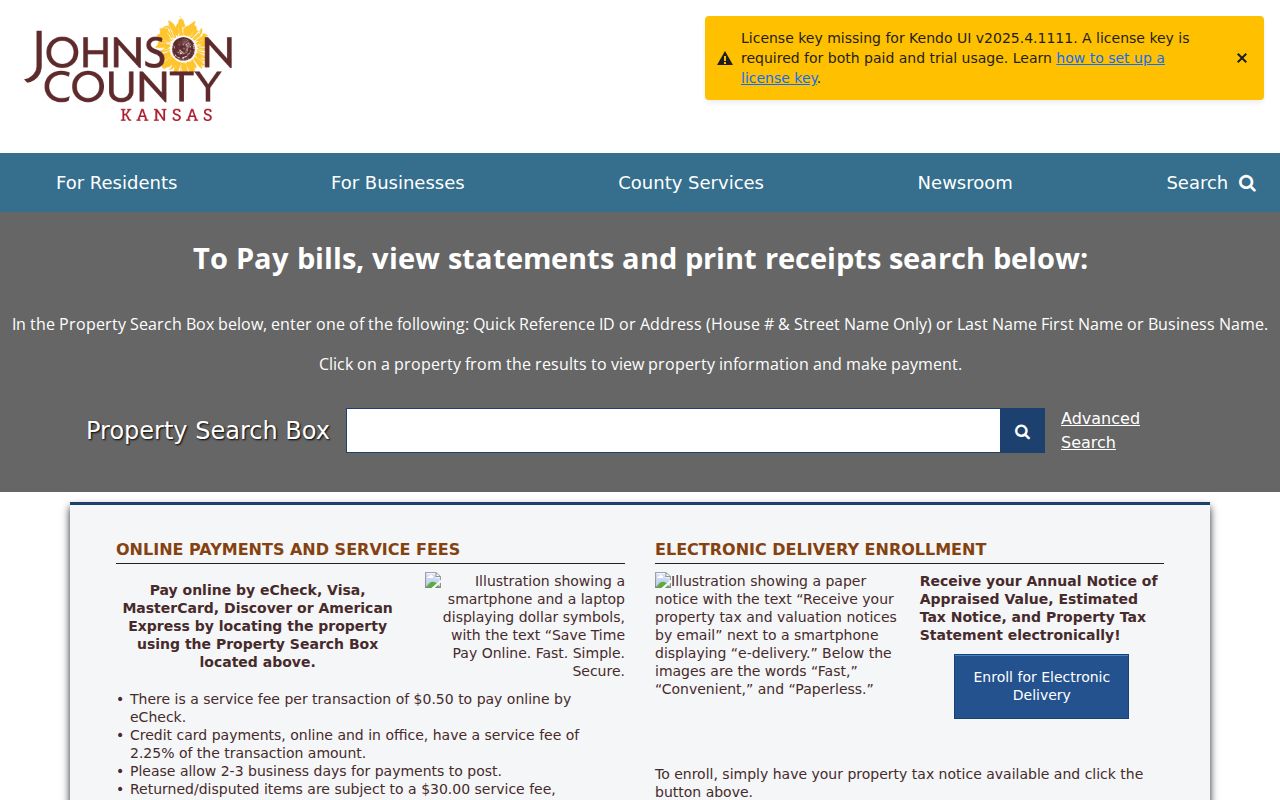
Its account fields can corroborate a parcel or mailing lead, but they should not be read as proof of present residence.
Shawnee Voter Record Boundaries
Kansas VoterView asks for identifying information and can return registration and polling details for the individual searched. It is not a browseable neighborhood roll. Johnson County separately publishes a voter-information request route, and Kansas election law limits use of voter data. Commercial use is prohibited under K.S.A. 25-2320a, sensitive identifiers are removed, and some residence addresses may be concealed under K.S.A. 25-2309.
Safe at Home participants use a substitute-address program administered by the Kansas Attorney General. Other restrictions can protect information tied to certain professions, and current vital records remain confidential under K.S.A. 65-2422d. A missing result can therefore reflect privacy, eligibility, spelling, or coverage rather than proving that a person has no Shawnee connection. Use only lawful personal research, and never use resident information to stalk, harass, intimidate, or harm anyone.
Shawnee Names Across Jurisdictions
Municipal, county, state, and postal labels answer different questions. Shawnee is the city, Johnson County keeps most land and county records, Olathe is the county seat, and USPS geography can cross municipal boundaries. AIMS can show city or township, ZIP, ward, precinct, subdivision, and Census geography on the same location card. Preserve every label as the source gives it.
This is especially important in historical work. Shawneetown, Gum Springs, Monticello, Woodland, Zarah, Wilder, Chouteau, Frisbie, and Holliday appear in Shawnee’s development and annexation history. An older deed, newspaper item, directory, or post-office reference may use one of those place names even when the present parcel falls within Shawnee. Treat the mismatch as a clue to date and jurisdiction, not as permission to silently convert an old address into a modern one.
Shawnee ZIP Directory Clues
The City’s November 2022 ZIP map labels eight ZIP areas associated with Shawnee: 66203, 66214, 66216, 66217, 66218, 66220, 66226, and 66227. The map is a practical orientation tool, while USPS remains the authority for validating the current postal form of a particular address. USPS expressly warns that its lookup does not confirm a person or company at the address.
Cross-check a postal result with AIMS before drawing civic conclusions. The county card can add municipality, parcel, ward, precinct, subdivision, and site-address detail. The Shawnee ZIP code directory explains the local grid, boundary mismatches, and how to keep postal and municipal geography separate.
Historical Shawnee Directory Trails
Shawnee history is spread across directory finding aids, local-history collections, archives, maps, and oral histories. The Library of Congress identifies Northeast Johnson County directories for 1953 through 1960 and Greater Shawnee Mission criss-cross directories for 1969 through 1972 and 1979. A criss-cross directory reverses the usual name-first order, making a street address or telephone number the entry point. Exact local publisher details and complete runs for every title were not verified, so consult the holding institution before planning a visit.
Johnson County Library’s Genealogy Desk and JoCoHistory add obituary and local-history citations, including an obituary card file covering 1977 through 2000. County Archives offers older tax, marriage, probate, court, land, and naturalization holdings through a research room and limited-search service. The Kansas State Historical Society preserves Johnson County collections, including Charles Clay Van Bebber Shawnee property deeds and title abstracts from 1881 through 1940. Read the full shelf and tracing method in the Shawnee city directory.
The Johnson County Library Genealogy Desk is a starting point for local directories and obituary references.
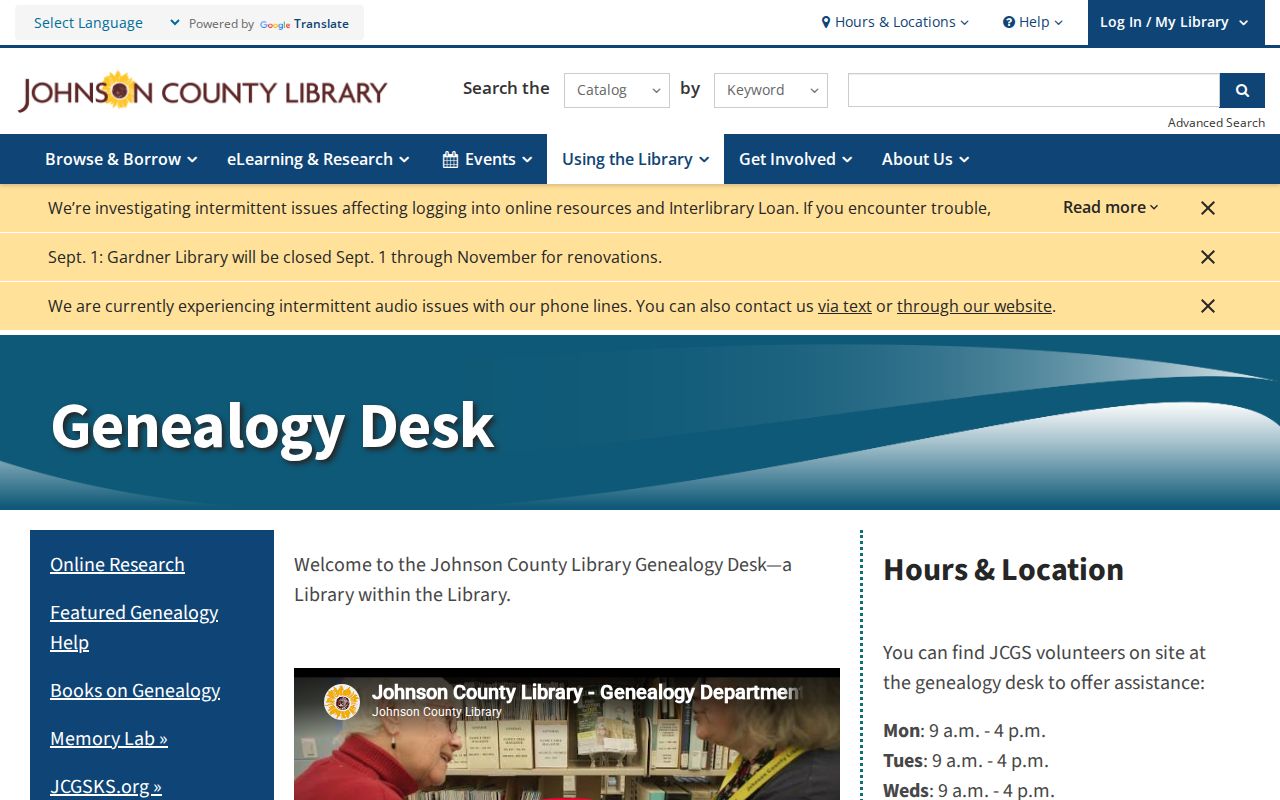
Library citations should retain the directory title, year, page, and address exactly as printed so later records can be compared without erasing historical place names.
Verify Shawnee Names Carefully
Court, vital, business, license, and public-safety sources can help distinguish people who share a name, but each comes with a firm boundary. Shawnee Municipal Court and Johnson County District Court are separate systems. The municipal online route is keyed to a citation or case number rather than a broad name search. Johnson County moved to the Kansas Courts statewide portal on November 5, 2024 for historical and new cases. When an online result is incomplete, use the courthouse terminal or send a defined request for a docket, complaint, disposition, or other named record. A court index is an allegation or case history, not proof of identity by itself.
The Kansas Secretary of State Business Entity Search and the Kansas professional license search can confirm an organizational or professional affiliation. Match the full name, entity or license status, address type, and date. Do not turn an office address or registered-agent address into a home-address claim. KBI and KDOC public-safety tools also warn that their databases may be incomplete or delayed, so they should never be presented as a complete history of a person.
Vital records require a different approach. The KDHE genealogy guidance says Kansas has no public vital-record index and treats current certificates as confidential. K.S.A. 65-2422d requires statutory eligibility, immediate-family status, direct interest, or supporting documentation for certified copies. Birth records in state custody begin July 1, 1911, marriage records begin May 1, 1913, and divorce records begin July 1, 1951. For earlier or inaccessible dates, use obituary citations, cemetery information, county marriage holdings, probate records, and directory entries as leads, while clearly labeling each source.
The Kansas vital-record genealogy page explains the confidentiality and eligibility rules before an order is attempted.
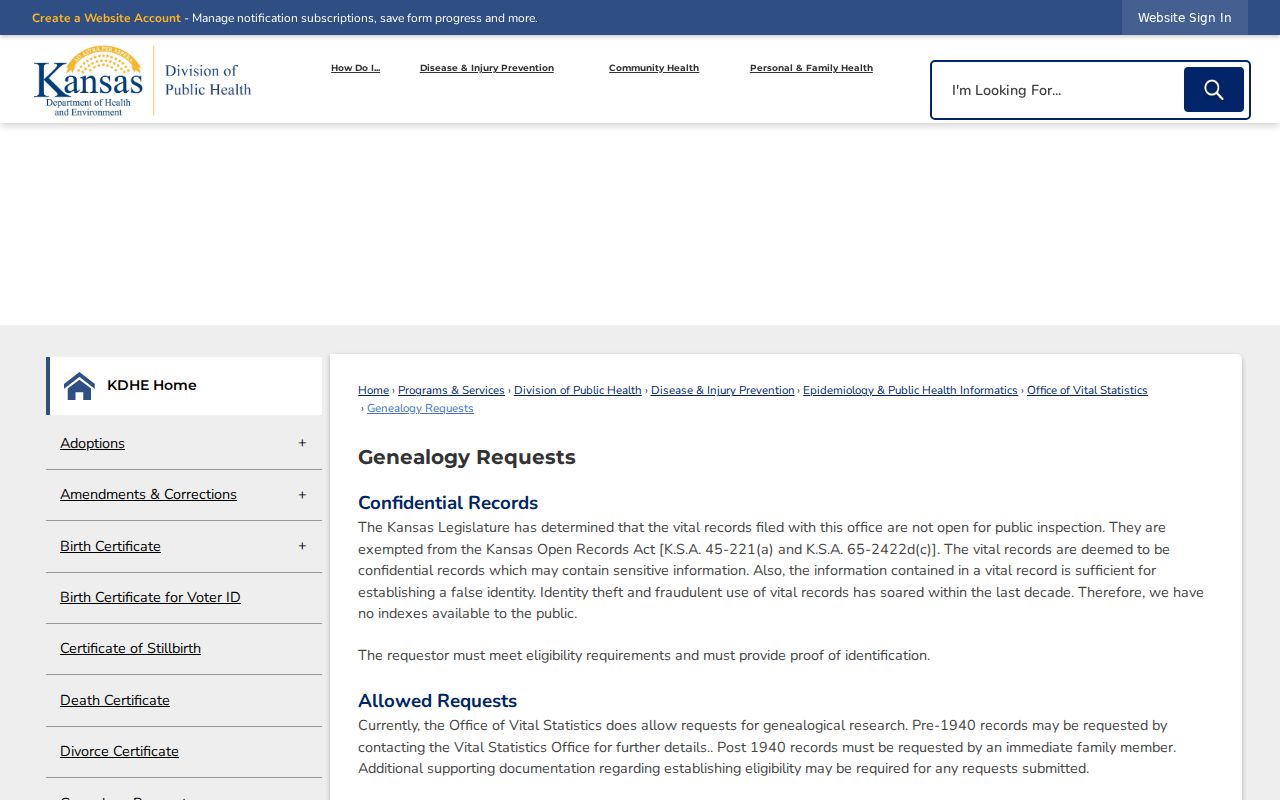
This state guidance marks the point where an open directory lead ends and a restricted certificate process begins.
Build A Shawnee Source Ledger
A simple source ledger prevents a plausible lead from becoming an unsupported resident claim. Give every item one row with the exact name as printed, record type, custodian, jurisdiction, record date, date accessed, address type, stable identifier, source URL or shelf citation, and any restriction or gap. Keep “site,” “mailing,” “owner,” “registered,” “historical,” and “recollection” labels intact. If two records use different spellings or place names, preserve both rather than silently choosing one.
| Ledger field | Why it matters | Shawnee example |
|---|---|---|
| Jurisdiction | Identifies the proper custodian | City of Shawnee, Johnson County, or Kansas |
| Address type | Stops ownership from being treated as occupancy | AIMS site address versus billing address |
| Date and era | Separates current from historical evidence | Directory year, deed reception, or tax year |
| Record identifier | Makes a result reproducible | KUPN, quick reference, case number, book and page |
| Gap note | Shows what was not verified | Blocked portal, missing year, or unexposed search fields |
Finish by asking what the record does not prove. The 2026 AIMS imagery was marked preliminary and unverified when researched. The new Register of Deeds public interface had not yet been posted. The City cemetery page displayed a “Search for a loved one” label without exposing an endpoint or coverage. No citywide street-renumbering conversion table was located. These are useful findings, not blank spaces to fill with guesses. Record them, use the documented counter, mail, library, archive, or KORA fallback, and recheck the official custodian when the research matters.
The AIMS parcel viewer provides the mapped parcel context used in that ledger.
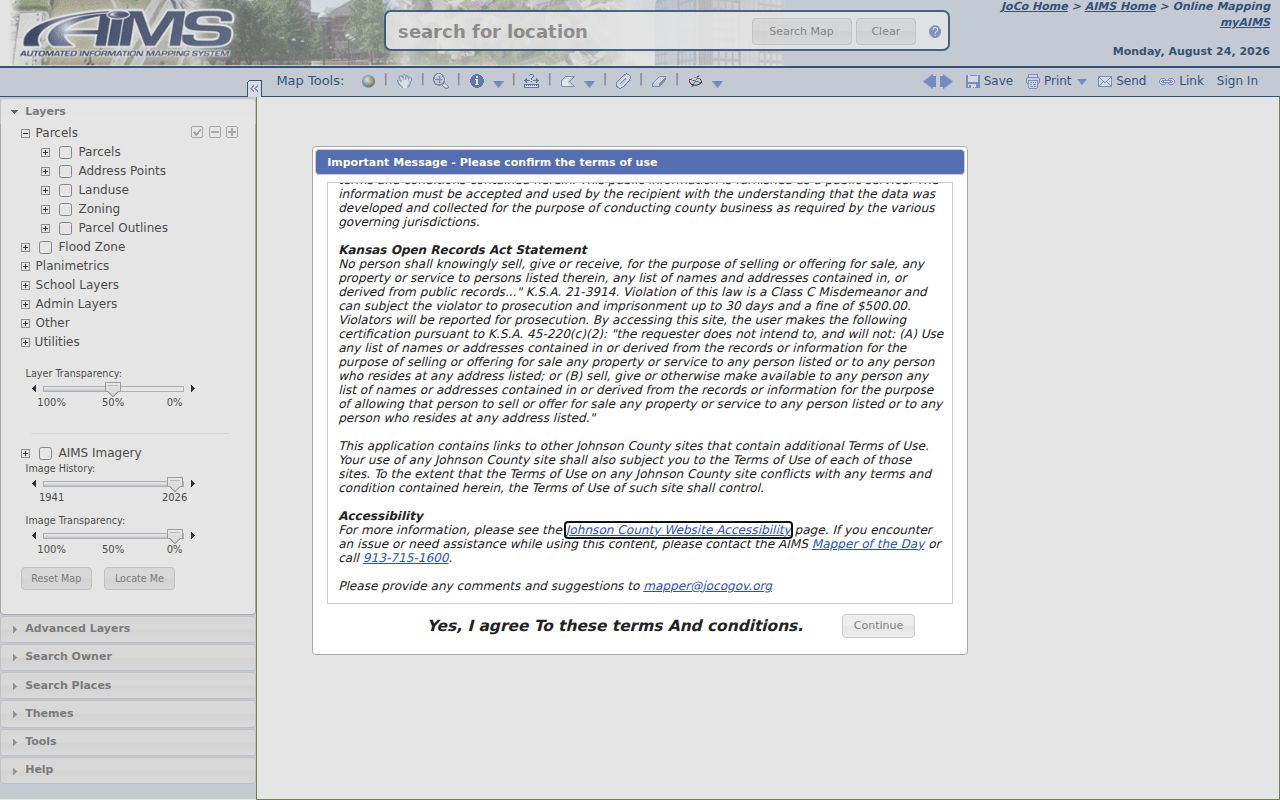
The viewer helps reproduce the parcel and boundary check while keeping its map disclaimer visible.